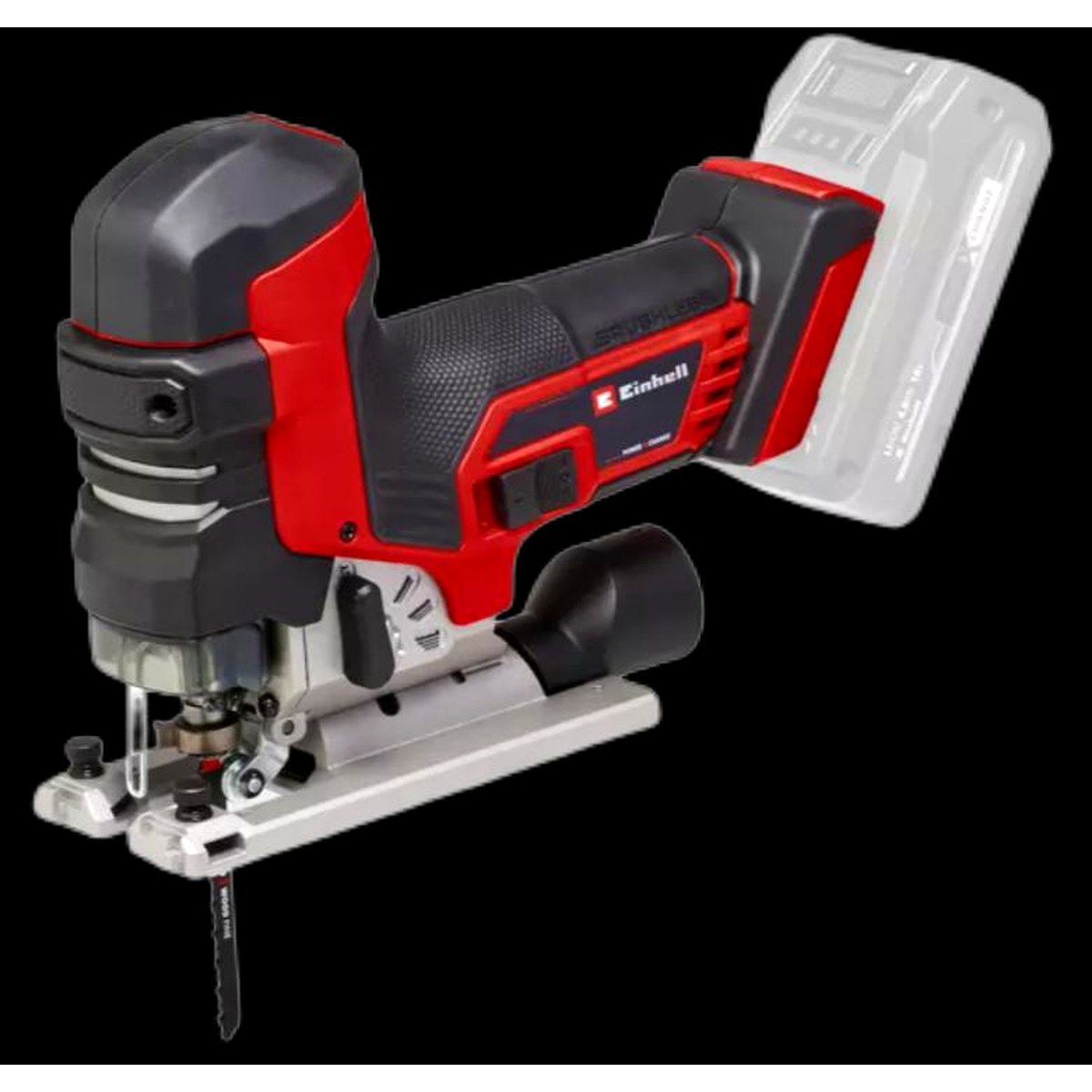
What actually fails on a tool housing label
There are five failure modes, and most printed constructions lose to at least three of them.
Heat. Angle grinders, chainsaws, welders and cut-off saws run hot at the housing. Adhesives soften, film faces curl, and edge lift starts at a corner.
Vibration. A drill or reciprocating saw feeds continuous high-frequency vibration into the housing. Anything stiff enough to hold its shape wants to peel at the edges under that load.
Oil, solvent and UV. Workshop fluids and sunlight attack printing ink from opposite directions: solvents lift it, UV bleaches it. Either way compliant text stops being readable — which is a documentation problem, not a cosmetic one.
Curvature. Modern housings are rarely flat. A flat sticker forced over a compound curve stores tension, and tension is exactly what pulls an edge up.
Abrasion. Tool branding lives on the same surface that gets dragged across concrete. Surface-printed graphics abrade; relief does not.
None of these are fixed by choosing a better sticker. They are fixed by changing what the nameplate is made of.
What a moulded silicone nameplate does instead
A moulded nameplate is not a printed surface — it is a solid piece of silicone formed in a steel mould. Logo, text and safety symbols are compression-moulded into the part itself, so there is no ink layer to wear through: take off the top 0.2 mm and the marking is still there, because the marking runs the whole way through.
- Relief instead of print. Logos and lettering stand up in 3D, with gradient colour fills and microtext fine enough for certification symbols.
- Flex instead of stiffness. The part absorbs impact and follows the housing, so vibration has nothing to lever against.
- A shape matched to the housing. Plates can be tooled to follow curves and arcs, flush or standing proud.
- Visibility options. Fluorescent or reflective grades for tools identified in poor light.
Specification we build to:
| Property | Value |
|---|---|
| Material | 100% food-grade platinum-cured silicone, FDA 21 CFR 177.2600 compliant |
| Temperature | −40 °C to 230 °C continuous, no deformation or cracking |
| Thickness | 0.8–3.0 mm |
| Maximum size | Up to 300 × 120 mm |
| Colour | Solid, gradient or dual-colour, Pantone matched |
| Detail | 3D relief and microtext at ±0.01 mm mould accuracy |
| Finish | Mirror polish, matte or embossed |
| Minimum order | 100 pieces per design |
| Sampling | 5–7 days |
| Production | 12–30 days |
Adhesion decides whether it survives
Most nameplate failures are adhesive failures, not silicone failures. A perfectly moulded plate still comes off if the backing is wrong for the housing.
We choose the backing from the housing material — ABS, nylon, painted metal or powder coat — instead of using one universal tape, and we put the plate on a running tool before releasing a production order, specifically to check edge lifting and detachment. Silicone helps here: being flexible, it dissipates impact rather than passing it into the adhesive line.
How it is made
- CNC engraving. The mould is cut at ±0.01 mm positioning accuracy so edges stay sharp and 3D reliefs survive to the finished part.
- Sandblasting and inspection. The surface is blasted to close porosity, then inspected — porosity telegraphs straight into the plate.
- Open mill refining. Compound passes through mill rollers at 50–70 °C three to five times to strip bubbles and impurities.
- Compression moulding. Pre-weighed solid silicone cures in the cavity under heat and pressure for uniform density.
- Finishing and packing. Edge definition and adhesion checked before packing.
Tooling is a one-off charge. The mould is dedicated to your design and repeat orders are not re-charged.
Where they go
Electric drills, angle grinders and chainsaws; welders and cutting equipment with genuinely hot bodies; garden and outdoor power equipment; OEM rating plates; service-part identification; industrial housings and control panels.
FAQ
How much heat can it take?
Our standard platinum-cured silicone holds from −40 °C to 230 °C in continuous service, which covers drill, grinder and saw housings and hotter welder bodies. Tell us a higher working temperature and we will quote the compound.
Will it lift under vibration?
No. The silicone absorbs impact rather than passing it on, the adhesive is matched to the housing, and plates are tested on running tools before production is released.
Can you match our Pantone colours and 3D logo?
Yes. Moulds are CNC-cut to ±0.01 mm, so reliefs, gradient fills and microtext stay sharp with no blur or glue overflow, and colours are matched to your references.
Can it follow a curved housing?
Yes. We tool the plate to the housing rather than forcing a flat sticker on it. Send a drawing or a sample and we will model the fit.
Minimum order and lead time?
100 pieces per design, sampling 5–7 days, production 12–30 days. Free 3D modelling before any steel is cut.